
T3MP3ST
T3MP3ST: Turning the AI you already run into a bug-hunter
A framework that points an everyday coding assistant at a security target and lets the hunt run itself.
What this means for you
Software runs almost everything you depend on: your bank, your hospital, the apps on your phone, the power grid behind the wall. All of it has weaknesses, and finding those weaknesses before a criminal does is a job called security testing. Until now that job needed years of training and expensive, specialist tools, so only a small number of professionals could do it, and they were not cheap. A proper test of a single system can cost a small company tens of thousands. Most simply skipped it and hoped.
T3MP3ST changes who can afford to try the door. It takes an AI assistant of the kind people already use to help write software, and turns it into a tireless inspector. You point it at a system you are allowed to test, and it works through the job the way a human expert would: hunting for a way in, checking whether that way actually opens, and writing up what it found so it can be fixed. It has already done this for real, finding genuine weaknesses in live software that no one had spotted before.
The part that makes it unusual is that it does not need its own expensive subscription or special access. It runs on the AI tool you already have. That is what puts serious testing within reach of a small team, a solo developer, or a charity that could never have paid for it the old way.
How to use it
This one asks a little more of you than reading a web page. It is free and open on GitHub (link at the top), but running it suits someone reasonably comfortable with software, the sort of person who already uses an AI coding assistant. If that is not you, this is a good tool to point a technical friend or colleague toward.
For those who do run it: you download it from GitHub and start what the project calls the “War Room”, which opens in your web browser. You connect the AI assistant you already use, describe the system you want tested in plain English, and let it work. There is no extra bill and no new account with the makers. The one firm rule is that you only ever point it at systems you own or have written permission to test.
Two things make it trustworthy. It shows its work, so every result it reports can be independently checked rather than taken on faith, and it is honest about what it can and cannot yet do rather than overselling. The quiet shift here is about who is allowed in: work that used to belong to a small, closed profession, opened up to far more of the people who need it.
What it is
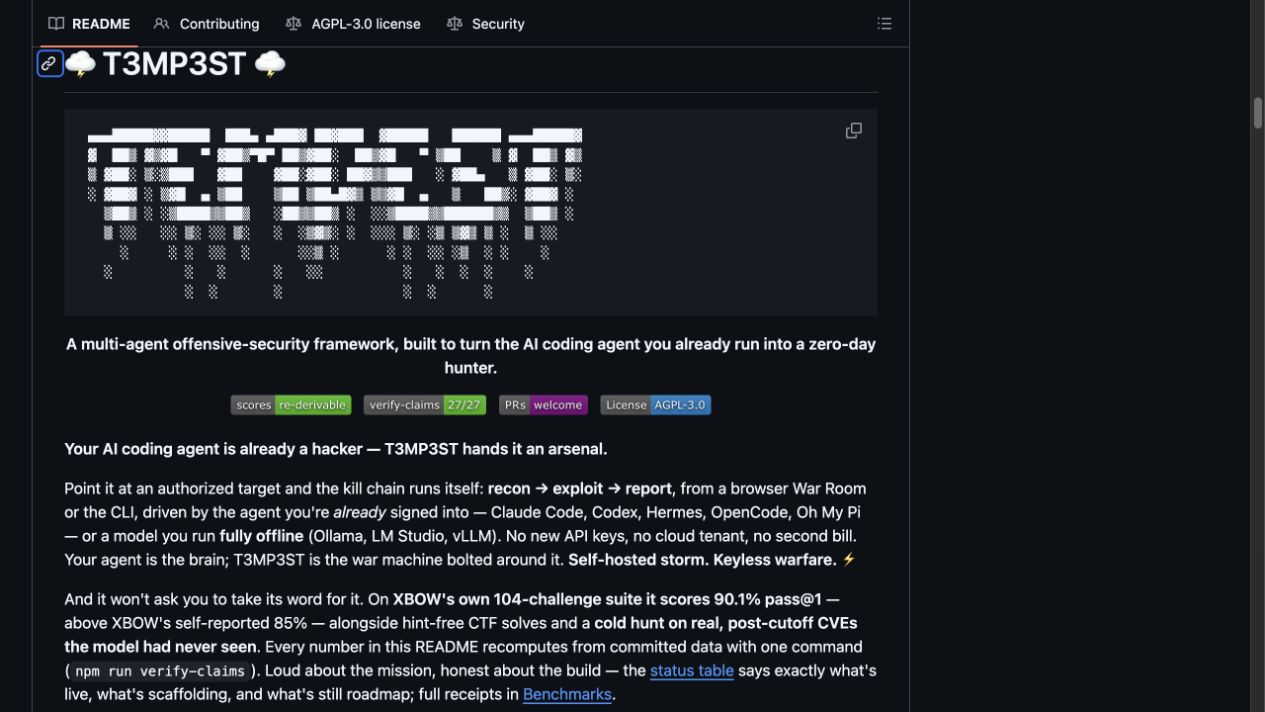
T3MP3ST is a multi-agent offensive-security framework. It wraps the AI coding agent you are already signed into (Claude Code, Codex, and similar, or a model you run fully offline via Ollama or an OpenAI-compatible server) and turns it into the driver of an automated security kill chain: recon → exploit → report, from a browser “War Room” or the CLI.
The three design claims
- Reproducible. Every headline number in the project recomputes from committed data with one command. A claim that can’t be re-derived doesn’t ship.
- Keyless. The agent already on your machine is the brain, no new API keys, no second subscription, no gatekeeper standing between a researcher and the tooling.
- Honest about scope. A status table marks exactly what is stable, what is scaffolding, and what is still roadmap.
What it reports today
| Web-app recon → exploit | stable |
| Hint-free CTF solves | stable |
| Coordinated OSS disclosure pipeline | stable |
| Cloud / mobile / binary analysis | scaffolding |
| Full 8-operator swarm | unbenchmarked |
On a public 104-challenge web-exploitation suite it reports ~90% pass@1 (above the suite author’s own self-reported figure), plus cold solves of real vulnerabilities disclosed after the model’s training cutoff. The engine is proven; the coordinated swarm is explicitly marked as the part still earning its stripes.
$ npm run verify-claims # re-derives every headline number
Authorized use
It is an offensive tool. It is built for systems you own or have written permission to test, provided as-is under AGPL-3.0, with the responsibility for staying in scope resting entirely on the operator. That constraint is part of the design, not a disclaimer bolted on.