
NATURALIS-HISTORIA
NATURALIS HISTORIA: The first encyclopedia, reopened
A free, illustrated reader for the 2,000-year-old book that tried to hold the entire world.
What this means for you
Around two thousand years ago, a Roman named Pliny the Elder tried to gather everything known about the world into a single enormous book: the stars, the seas, elephants, medicines, pigments, monsters, memory, gossip. It is called the Naturalis Historia, and it is often described as the first encyclopedia. He died in 79 AD sailing toward the eruption of Vesuvius, partly to rescue people and partly because he wanted a closer look.
For most of us, a book like that is locked away. It is in ancient Latin, it survives mainly in scholarly editions, and it is hard to even approach. This project unlocks it. It is a free website where anyone can read the whole thing, the original Latin laid out beside an English translation, search it for any word, browse it by subject, or press a button named Fortuna to be dropped onto a random page.

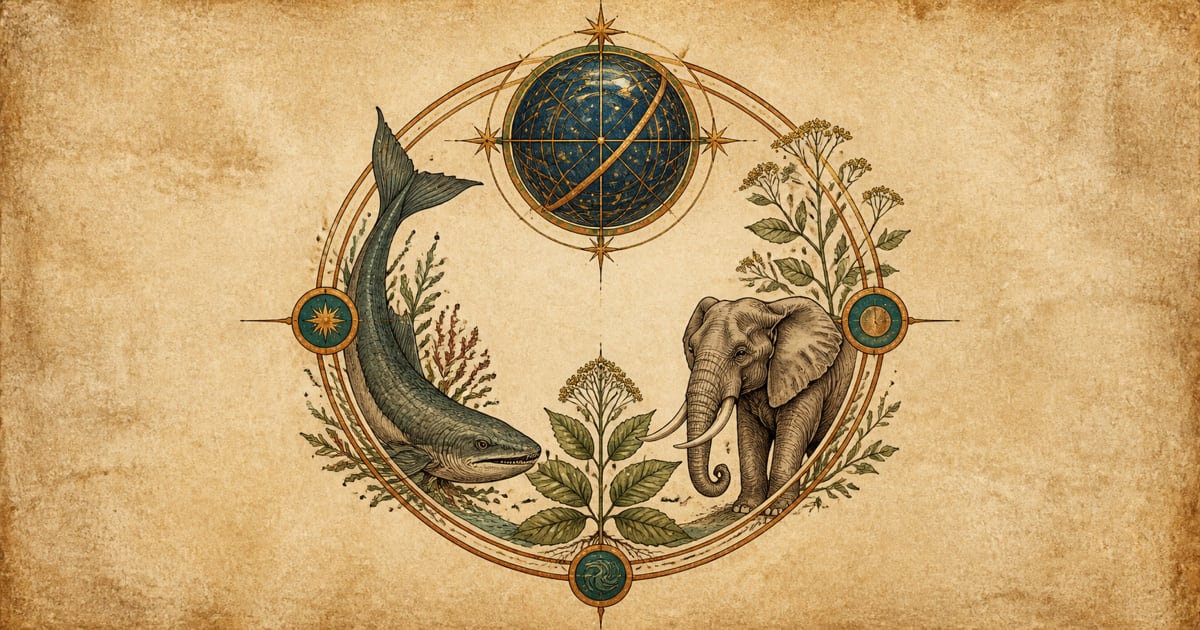
And there are a lot of pictures: 1,065 of them, one for each chapter, every one made with AI. A chapter on how Romans believed elephants mourned their dead has its own scene. So does the one on making purple dye from sea snails. The old words finally have a window to look through.

Because the pictures are AI-made, the project is unusually honest about them. Every image is logged and traceable, and the project states plainly that the pictures are there for wonder while the words are the real, historical text. As it puts it, wonder is welcome; confusion about the evidence is not. That matters at a time when it is easy to pass AI pictures off as something they are not.
How to read it
Just open the website at the link above. It is free, there is nothing to install, and you do not need an account. Read it online, search for whatever you are curious about, or let Fortuna choose for you. If you want the underlying project, every bit of it is open on GitHub too.

It is a strange thing for a group working at the frontier of AI to spend its time on a Roman book. That is rather the point. The technology is worth having when it opens knowledge up and hands it back to people, instead of locking it behind a wall.
What it is
A complete open digital edition of Pliny the Elder’s Naturalis Historia: all thirty-seven books, split into 1,065 bilingual Latin–English reading units, paired with 1,065 original AI-generated illustrations, one per chapter. It is a static web application, deployed on Cloudflare, with the project code under AGPL-3.0.
The texts
The Latin is Mayhoff’s 1906 edition, sourced through the Perseus Digital Library (derived data CC BY-SA 4.0). The English is the Bostock and Riley translation of 1855–57, from public-domain Project Gutenberg volumes. The Latin is presented first, the English second, and both remain real, selectable text rather than images. Pliny the Younger’s two Vesuvius letters (Epistulae VI.16 and VI.20) are included as a clearly marked afterword, outside the Elder’s corpus.
The reader
Full-work positional search, a complete index, previous/next history, and “Fortuna,” a random-chapter jump. Responsive layouts, a focus mode, fullscreen plates, and reduced-motion support round it out.
The illustrations, and the provenance discipline
Each of the 1,065 plates is an independently generated 1536×1024 scene, prompted for its specific chapter, reviewed, hashed, receipted, and assigned exactly once through a manifest. No recycled atlas art, no shuffled crops. Every plate carries a source hash, a generation record, a rights record, and its one-to-one manifest assignment; the public provenance.json ledger records the lot. Delivery is responsive AVIF, WebP, and JPEG. The claim boundary is stated plainly: the pictures carry no textual authority, the words do.
The interesting part for a researcher is the receipts, not the pictures: it is a worked example of publishing AI-generated media with a full, checkable provenance chain and an explicit boundary on what the AI output is and is not allowed to claim.